

When families begin searching for a Goldendoodle puppy, they often focus on:
But one of the most important factors is often overlooked completely:
Where and how the puppy was raised.
At The Doodle Nook, we believe a puppy’s early environment plays a major role in shaping future behavior, confidence, adaptability, and emotional stability. Two puppies can look nearly identical online while having completely different early life experiences.
Those early experiences matter more than many first-time dog owners realize.
A puppy raised inside a home environment often experiences:
Meanwhile, puppies raised primarily in isolated kennel settings may experience very different developmental conditions.
This does not mean every kennel-raised puppy will struggle or every home-raised puppy will automatically become perfect. Responsible care can exist in different forms.
However, environment during the first several weeks of life has a significant impact on:
This guide explains:
At The Doodle Nook, we believe informed families make better long-term puppy decisions.
Puppy development begins long before families bring their dog home.
The earliest weeks influence:
During this stage, puppies learn how the world works.
That learning happens through:
At The Doodle Nook, we view these early weeks as foundational for long-term emotional development.
Home-raised puppies are generally raised within a family-style environment rather than in isolated kennel buildings.
That often includes exposure to:
Puppies raised in these environments often become more familiar with normal daily life before leaving for their new homes.
At The Doodle Nook, we believe gradual exposure creates smoother transitions later.
Many new puppy owners are surprised by how sensitive young puppies can be to unfamiliar sounds.
A puppy raised with regular household exposure may become more comfortable around:
These experiences help puppies learn that normal daily sounds are not dangerous.
Confidence grows through repetition and positive exposure.
Puppies learn about people through consistent handling and interaction.
Frequent gentle handling helps puppies become more comfortable with:
At The Doodle Nook, we believe early positive interaction strengthens:
Puppies raised with regular human interaction often adjust more naturally to family life.
Not all kennels are the same.
Some responsible breeders operate extremely clean, structured kennel facilities while still prioritizing:
Others may provide minimal environmental stimulation.
The issue is not simply whether a breeder uses a kennel.
The real question is:
How much enrichment, interaction, and developmental support are the puppies receiving?
At The Doodle Nook, we encourage families to ask detailed questions about daily puppy experiences rather than assuming all environments are identical.
Young puppies repeat experiences constantly during development.
Repeated exposure to:
helps create familiarity.
Familiarity reduces fear later.
That’s one reason puppies raised in active home environments often transition more smoothly into:

Confident puppies are not puppies who never experience stress.
Confident puppies are puppies who learn how to recover from new experiences safely.
At The Doodle Nook, early exposure is introduced gradually so puppies can:
Small positive experiences help puppies become more emotionally flexible as adults.
Puppies raised with limited interaction may have fewer opportunities to build:
Limited exposure during critical developmental periods can sometimes contribute to:
That’s why early socialization matters so much.
Families frequently notice that home-raised puppies may adapt more naturally to:
This does not mean transition is effortless.
All puppies still need:
But familiarity with everyday life often helps reduce overwhelm during those first adjustment weeks.
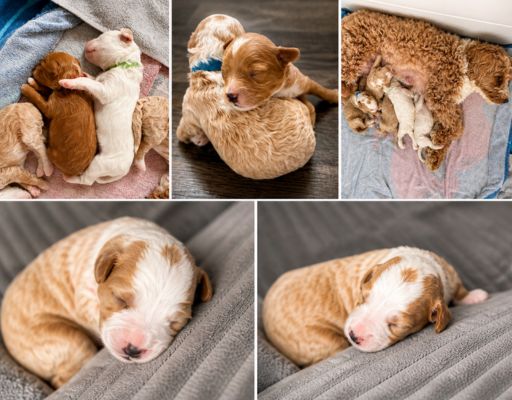
At The Doodle Nook, we begin introducing puppies to routine concepts early whenever possible.
Even young puppies begin developing habits related to:
Early environmental structure can help puppies transition into potty training more successfully after going home.
Goldendoodles require lifelong grooming.
That means early handling matters tremendously.
Puppies introduced positively to:
often become easier adult dogs to groom.
At The Doodle Nook, positive grooming exposure is part of helping puppies develop confidence with handling.
Young puppies absorb information constantly.
They observe:
A stimulating but calm environment helps puppies become:
Puppyhood experiences often influence:
At The Doodle Nook, we believe confident dogs are built through:
not through isolation.
Instead of asking only:
“Are the puppies home raised?”
Families should ask:
These questions reveal much more about developmental quality.
Goldendoodles are highly social companion dogs.
They often form strong emotional bonds with people and thrive in environments where they feel connected and included.
Because they are intelligent and emotionally responsive, early experiences can strongly influence:
At The Doodle Nook, we prioritize early social interaction because these dogs are bred to live closely alongside families.
A spotless facility does not automatically equal strong puppy development.
Puppies also need:
True puppy development involves more than sanitation alone.
Some differences become more obvious after puppies go home.
Puppies raised with structured exposure may adjust more comfortably to:
Again, every puppy is individual.
But environment influences confidence significantly.
At The Doodle Nook, we believe breeding goes beyond producing puppies.
We focus heavily on:
Because a puppy’s first weeks help shape:
Reality:
All puppies still require training, structure, and patience.
Reality:
Some kennel programs provide excellent enrichment and care.
Reality:
Early developmental experiences strongly influence confidence and adaptability.
Reality:
Critical socialization windows occur very early in life.
At The Doodle Nook, our goal is not simply sending puppies home quickly.
We focus on:
Those outcomes begin during the earliest stages of puppyhood.
Yes. Positive grooming exposure during puppyhood often improves future cooperation.
Helpful exposure may include:
Genetics matter, but environment and early experiences matter too.
Temperament, genetics, and early developmental experiences all influence adaptability.
At The Doodle Nook, we believe early puppy environment plays a major role in shaping future family companions.
A puppy’s first weeks influence:
Home-raised environments often provide valuable exposure to:
But what matters most is not simply whether puppies are raised “inside” or “outside.”
What truly matters is:
The goal is not simply finding a cute puppy.
The goal is finding a puppy raised with intentional care, emotional support, and early experiences that help prepare them for a confident life as part of a family.
EXCELLENT Based on 9 reviews
 Posted on Google
 Christy HeuglinI absolutely love my sweet lil fur baby I got from The Doodle Nook. They are so organized, detailed, communicative and professional. I highly recommend!!!!Posted on Google
 Laken NickellTayshia was so kind and answered all of my questions when getting our sweet honey from her. She was always updating me and sending me pictures of our puppy we chose. Her doodles are raised in her home and well socialized. Her children are always playing with the puppies and getting them used to kids too so that was a major plus for us. I have no complaints. I would 10/10 recommend getting your pup from the doodle nook 😊Posted on Google
 Clayton EmeryThe owners at Doodle Nook are easy and pleasant to deal with. Looking forward to working together again on my next puppy purchase! 🤝Posted on Google
 Shelby GreenTayshia is absolutely amazing with her animals and treats them like her own kiddos. Highly recommend!Posted on Google
 Kortney KellerThe Connor’s take such good care of the mama and puppies! Would highly recommend them based off of the care and consideration towards their animals and the guarantee of a well run business!Posted on Google
 Alana Fishel10/10 amazing family! Pups and mama are deeply loved and well cared for. Pups get a ton of human interaction and would be the perfect addition to your family ❤️Posted on Google
 Emma SommerI’ve known the Conners for many years! Penny is loved deeply through the entire family! Her puppies are growing up in a lovely home setting, getting used to so many things! I’m so excited to have one of our own!Posted on Google
 Alexandra VacaYou can tell how much love and care goes into raising these puppies. They are well cared for, socialized, and absolutely adorable. Communication is wonderful throughout the process, and it’s clear this breeder truly cares about both the puppies and the families they go to. Highly recommend!